
Why make a will?
- Why should I have a will?
- What happens if I die without a Will?
- I'm not married but live with a partner - what happens to my estate?
- Doesn't my spouse get everything when I die anyway?
- Avoid sideways disinheritance.
- No Protection of assets for the future
- No Will - If you're married (or in a civil partnership) with children
- No Will - If you're married (or in a civil partnership) without children
- No Will - If you have an un-married partner (and are not in a civil partnership)
- No Will - If you have no spouse or partner
Why should I have a will?
Regardless of our wealth and assets everybody has a responsibility to make a will as dying without one means our loved ones are left with the headache of sorting out our estate.
More importantly it is then the government who decide what happens to our belongings, property and money, they would even decide who would care for our children if we die leaving children under 16 behind.
There are many reasons to make a will but ultimately it is all about controlling how your estate is distributed upon your death, what happens to, and who benefits from your hard earnt gains through your life. For some it is a key element in how they wish to be remembered.
Where a person dies without making a will they are said to have died “intestate”. This means your estate is distributed according to the rules of intestacy. This can cause many problems, for example, the rules of intestacy make no provision for un-married couples or stepchildren. Crucially even if you are married your spouse or civil partner may not inherit the whole of your estate.
Other reasons to make a will include;
- Ensuring your estate is left as tax efficient as possible helping to ensure your loved ones don’t end up having to pay more tax than is necessary.
- Using a will as an opportunity to decide on a guardian to look after young children in the event of your death is very important for those with young children.
- Stating how you would like your body to be disposed of after your death is an important reason for some.
- Finally by making a will you also have the opportunity to leave specific gifts for friends and/or charities.
Remember without a will;
- Your entire estate will go to the Taxman if you have no spouse or blood relatives,
- Your Inheritance Tax liability could be higher
- You are not able to protect some or all of your estate against long term care fees
- If you have children under 18, and the other parent is also dead, you have effectively given up the right to decide who cares for them
- If you have a co-habiting partner, he/she will get none of your estate even if you have been together for many years as the Intestacy Laws do not recognise unmarried "Common Law" partners
- Your Estate will cost a lot more and take a lot longer to distribute
- You cannot decide who inherits what and neither can your family
What happens if I die without a Will?
If there is no will
If there is no will (known as dying intestate) the process is more complicated. An application for a grant of letters of administration (an official document, issued by the court, which allows administrators to administer the estate) will need to be made. The person to whom letters of administration is granted is known as the administrator. The administrator is the person who has the legal right to deal with the affairs of the person who has died, and is determined by a set order of priority. The Law Society
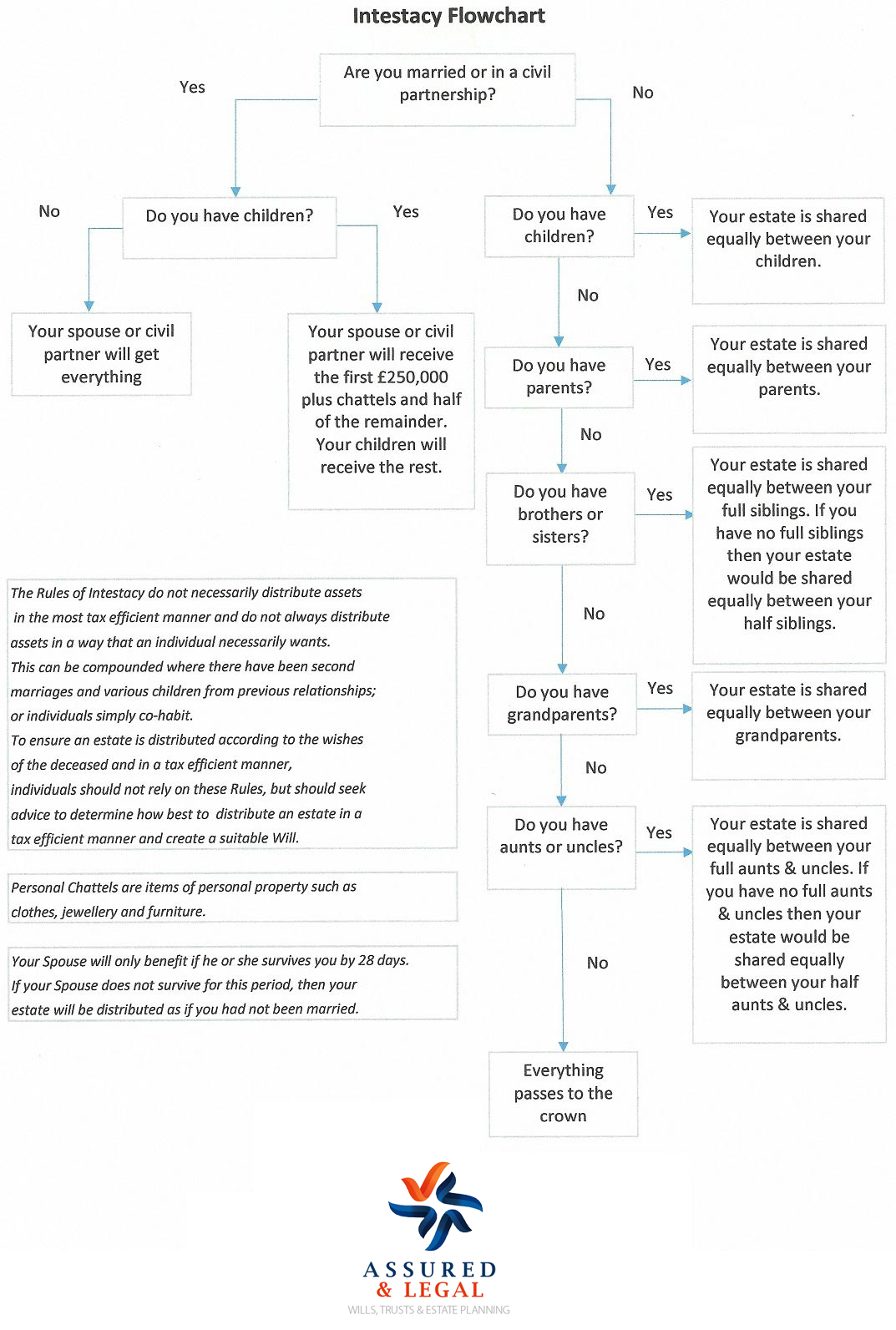
Without a valid will the rules of intestacy decide who inherits your assets, they will apply differently depending on your circumstance. The following rules are for deaths on or after 10 February 2015 in England and Wales.
If you're married (or in a civil partnership) with children
The husband, wife or civil partner won't get everything however they will receive:
- £250,000 tax free
- A life interest in half of the remaining estate (on his or her death this will pass to the children)
- Chattels (Belongings such as clothes, furniture, cars etc. but nothing used for business purposes)
- The rest of the estate will be shared amongst the children.
If you're married (or in a civil partnership) without children
The husband, wife or civil partner won't get everything however they will receive:
- £450,000 tax free
- Chattels (Belongings such as clothes, furniture, cars etc. but nothing used for business
purposes)
- Half of the remaining estate
The other half of the remaining estate will be shared by the following:
- Any surviving parents
- If there are no surviving parents, any brothers and sisters (who shared the same two parents as the deceased) will get a share (or their children if they died while the deceased was still alive)
- If the deceased has none of the above, the husband, wife or registered civil partner will get everything)
If you have an un-married partner (and are not in a civil partnership)
You won't get a share of your partner's estate if they die without making a will. If they haven't provided for you in some other way, your only option is to make a claim under the Inheritance (Provision for Family and Dependants) Act 1975 'If you feel you've not received reasonable financial provision', this will take time and there are no guarantees.
If you have no spouse or partner
The estate is distributed as follows:
- To surviving children in equal shares (or to their children if they died while the deceased
was still alive)
- If there are no children, to parents (equally, if both alive)
- If there are no surviving parents, to brothers and sisters (who shared the same two parents as the deceased), or to their children if they died while the deceased was still alive
- If there are no brothers or sisters then to half brothers or sisters (or to their children if they died while the deceased was still alive)
- If none of the above then to grandparents (equally if more than one)
- If there are no grandparents to aunts and uncles (or their children if they died while the deceased was still alive)
- If none of the above, then to half uncles or aunts (or their children if they died while the deceased was still alive)
- To the Crown if there are none of the above
I'm not married but live with a partner - what happens to my estate?
If you have an un-married partner (and are not in a civil partnership) you will NOT get a share of your partner's estate if they die without making a will and they will not benefit from yours. If they haven't provided for you, and you for them in some other way, the only option is to make a claim under the Inheritance (Provision for Family and Dependants) Act 1975 'If you or they feel that you've not, or they have not, received reasonable financial provision', this will take time and there are no guarantees and it is likely that you will require legal help which will be costly.
Doesn't my spouse get everything when I die anyway?
If you're married (or in a civil partnership) with children the husband, wife or civil partner won't get everything however they will receive: £250,000 tax free, A life interest in half of the remaining estate (on his or her death this will pass to the children), Chattels (Belongings such as clothes, furniture, cars etc. but nothing used for business purposes). The rest of the estate will be shared amongst the children. Note, that with a small estate, the partner may receive everything and the children nothing.
Avoid sideways disinheritance.
If the partner inherits everything by default of the intestacy rules and then at a later time remarries without making a will and predeceases their new partner, your assets/your lifetimes hard earnt gains would automatically end up in the possession of a third party disinheriting your children altogether.
No Protection of assets for the future.
Without a will (or trust) there can be no protection provided for your future generations, ie. as noted above sideways disinheritance can occur and furthermore your share in your property can be left vulnerable to unforeseen expenses in later life for both yourself and/or your surviving partner.
A will can provide far more than just peace of mind and as none of us have a crystal ball, it should be in place sooner rather than later. It’s not something you can do after the event!
If you need information on estate planning to prevent this happening to you and yours, or you would like a no obligation general review call 01794 501 036 or go to appointments and we’ll contact you.
T's & C's are one free will per household, over 50 years only.